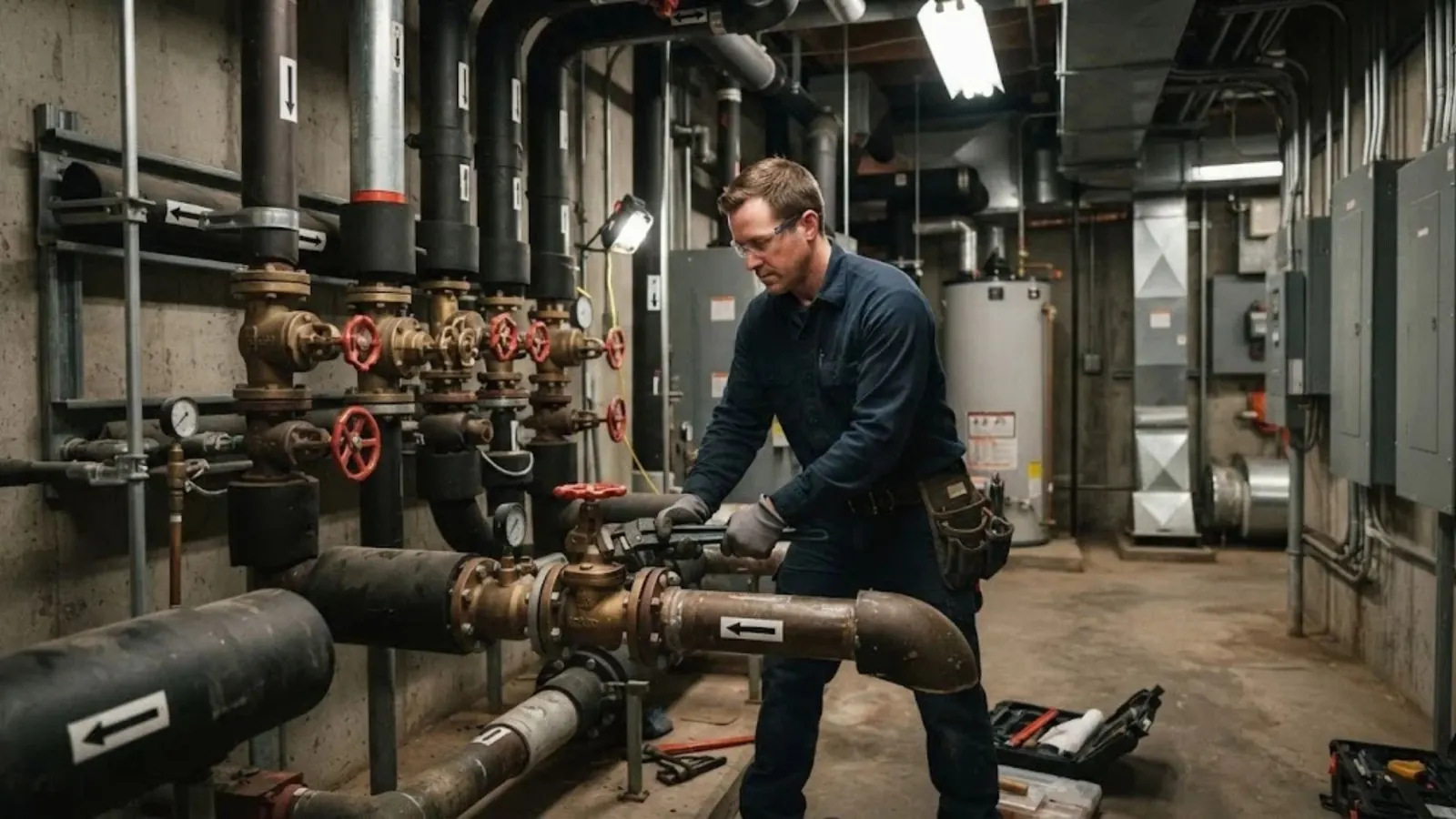
Commercial plumbing in El Mirage, AZ covers the water, drain, and gas piping in shops, offices, restaurants, and other businesses, which usually run bigger and busier than a house. If water is spreading through your space right now, close the main valve and call our 24/7 line while you wait.
Business plumbing differs from home plumbing in a few ways. More people use the fixtures, the pipes are larger, and a leak can shut the doors for the day. A plumber also has to think about tenants, landlords, and the rules that apply to a business.
Grand Avenue (US 60) is the main commercial corridor in town. Many small businesses along it share buildings and sometimes share plumbing, which is a good reason to know who is responsible for what before an emergency starts.
When a business has to call now
Some problems cannot wait for the next business day. Sewage on a floor, a burst supply line, or a gas smell in the building changes who you should call first.
- Gas smell: leave the building and call the gas utility or 911 before you call a plumber.
- Burst or spraying pipe: close the nearest shutoff valve or the main, and tell staff to stay clear.
- Sewage backup: stop using restrooms and sinks, and keep customers and staff out of the wet area.
- Water near electrical panels or outlets: leave the area and shut off power only if it is dry and safe to reach.
- Call the 24/7 line, and if you rent, tell your landlord or property manager as well.
What kinds of businesses call a commercial plumber
Needs vary by building. These are the jobs that come up most often for small and mid-size businesses.
Restaurants and food service
Kitchen drains, floor drains, and water heaters work hard all day. Grease can clog lines quickly.
Offices and retail
Restrooms, break rooms, and a single water heater are the main systems. Leaks often hide in ceilings.
Multi-tenant buildings
Shared lines and shared meters make it harder to tell where a leak starts.
Light industrial and storage
Larger water lines, floor drains, and sometimes process piping.
Churches, schools, and care sites
High restroom counts and strict needs for hot water and safe temperatures.
Common commercial problems and what the plumber does
| Problem | Likely cause | What the plumber does |
|---|---|---|
| Restrooms back up at rush hour. | Main line blockage or undersized drain. | Clear the line, then scope it to find roots, grease, or damage. See drain cleaning. |
| Floor drain smells or gurgles. | Dry trap, partial clog, or a vent issue. | Check the trap, flush the drain, and look at the vent route. |
| Water bill jumps. | Hidden leak, running fixture, or irrigation fault. | Run a meter test, then isolate zones of the building. |
| Not enough hot water. | Undersized or failing heater, or scale. | Check the heater and recirculation, then discuss repair or replacement. |
| Wet spot on a ceiling. | Leak above, a drain line, or a roof problem. | Trace upstream, check fixtures above, and rule out the roof. |
Finding leaks in a commercial building: what to expect
Commercial leak detection starts the same way as in a home. The plumber reads the meter with all water use stopped, then shuts off zones of the building to see which one loses water. In a large building, this alone can take time, because tenants, equipment, and irrigation all use water.
After that, the plumber may use listening gear, thermal imaging, or pressure testing to narrow the area. Each has limits. Thick concrete, large pipes, and background noise can hide a small leak, and a result is often a strong clue and not a final answer.
The plumber confirms the location on site before recommending any cutting or digging. Ask for the plan in plain words, and ask what the plumber cannot rule out. For details on methods and limits, see leak detection.
Backflow testing and prevention
A backflow preventer is a valve assembly that stops used water from flowing backward into the clean supply. Businesses often have them on irrigation lines, fire lines, and some equipment connections. The city lists a Backflow Prevention page among its water resources, so it is a topic the water utility cares about.
Many of these devices need to be tested on a schedule. Who requires the test, how often, and who is allowed to perform it depends on the device and the utility. Do not assume a plumber's visit satisfies a requirement. Ask El Mirage customer service or the Water Services Division what your property needs.
On site, the plumber confirms what is installed, where it sits, and whether it looks damaged or leaking. A dripping relief port, a missing device, or a cracked body are signs that something needs attention. Ask the plumber what they can do themselves and what must go to another tester.
Restrooms down or water spreading?
Close the nearest valve, keep customers clear, and call. A plumber can help you decide what stays open.
Commercial water heaters and hot water demand
A business water heater may be larger than a home one, and some are shared across tenants. Signs of trouble include rusty water, popping noises, leaks at the base, and hot water that runs out too soon. The cause might be scale, a failed element or burner, or a tank that is too small for current use.
The plumber checks the heater, its fuel supply, relief valve, and the piping around it. If the unit is old, repair may only buy a short time. See water heater replacement if it is time to consider a new one.
Hard water adds to scale in tanks. The city's 2024 water quality report lists hardness from 4 to 9 grains per gallon with an average of 7. Check the latest report and ask the plumber whether a flush or treatment makes sense for your building.
Who is responsible when you rent?
In a leased space, the lease often decides who pays for what. The landlord may own the main lines and the building shell, while the tenant covers fixtures and equipment inside the suite. Read the lease before you call, and notify the landlord about any leak right away.
The plumber can describe what they find and where the pipe sits. They cannot decide who pays. That is a matter between you and the property owner.
Gas piping in a business
If you smell gas, leave the building and call the gas utility or 911 before you call a plumber. Do not turn lights or equipment on or off on your way out. A plumber can help with gas piping once the utility says it is safe to proceed.
El Mirage adopted the 2018 International Fuel Gas Code in 2023, with a local amendment on how deep underground gas piping must be buried. Ask the El Mirage building department what a gas job at your address requires.
How a service call usually goes
Call and describe the building
Tell dispatch what kind of business it is, where the problem is, and whether you rent.
Stop the damage
The plumber confirms the shutoff and closes the right valve if you have not.
Find the cause
The plumber checks pressure, fixtures, and drain flow, and uses a camera or listening gear when needed.
Explain the options
You get the choices, the trade-offs, and a clear price before work starts.
Repair and test
After the repair, the plumber tests the line and tells you what to watch for.
Document it
Ask for a written note of findings for your landlord or insurer.
A short checklist to have ready
A little preparation saves time during an emergency.
- Know where the main water shutoff is and make sure staff can reach it.
- Label the shutoffs for restrooms, kitchen, and water heater.
- Keep the landlord's and property manager's numbers by the front desk.
- Photograph damage before cleanup for the insurance claim.
- Keep a list of any backflow devices on the property and their last test dates.
What affects the price of commercial work
Commercial jobs vary more than residential ones. The plumber confirms the scope on site, and the price comes before work starts.
A commercial property or business policy may cover sudden water damage, but not the cost of fixing a worn-out pipe. Policies differ on what counts as business interruption. Read your policy and ask your agent before you file.
Want a real number for your building? Call the 24/7 line and describe the problem. (623) 301-9042
Frequently asked questions
Yes. The 24/7 emergency line is answered at night, on weekends, and on holidays. Tell dispatch what kind of building it is and where the water is.
Usually the plumber can narrow it down by testing zones and using listening or thermal tools. Large buildings and thick concrete can make the result less certain. The plumber confirms on site and tells you how sure the finding is.
The plumber can inspect what is installed and tell you whether it looks damaged. Testing rules depend on the device and the utility, so ask city customer service what your property needs. Ask the plumber on the call what they can handle.
It depends on the job. Ask the El Mirage building department before work begins. The plumber can tell you what is typical.
Close the nearest shutoff, call the plumber, and tell your landlord. The lease decides who pays, so keep records of what you find.
Yes, the same line serves neighboring towns. See the Peoria plumber page or the Surprise plumber page for more.
Yes. The plumber clears the line and looks at why it clogged, since grease and debris often return. See hydro jetting for a heavier cleaning method.
Question not answered here? Call (623) 301-9042
Sources and code notes
Code reference: El Mirage follows the 2018 International Plumbing Code (IPC) and the 2018 International Fuel Gas Code (IFGC). Ask the El Mirage building department which rules and permits apply to your job. Hardness figures come from the City of El Mirage 2024 water quality report.