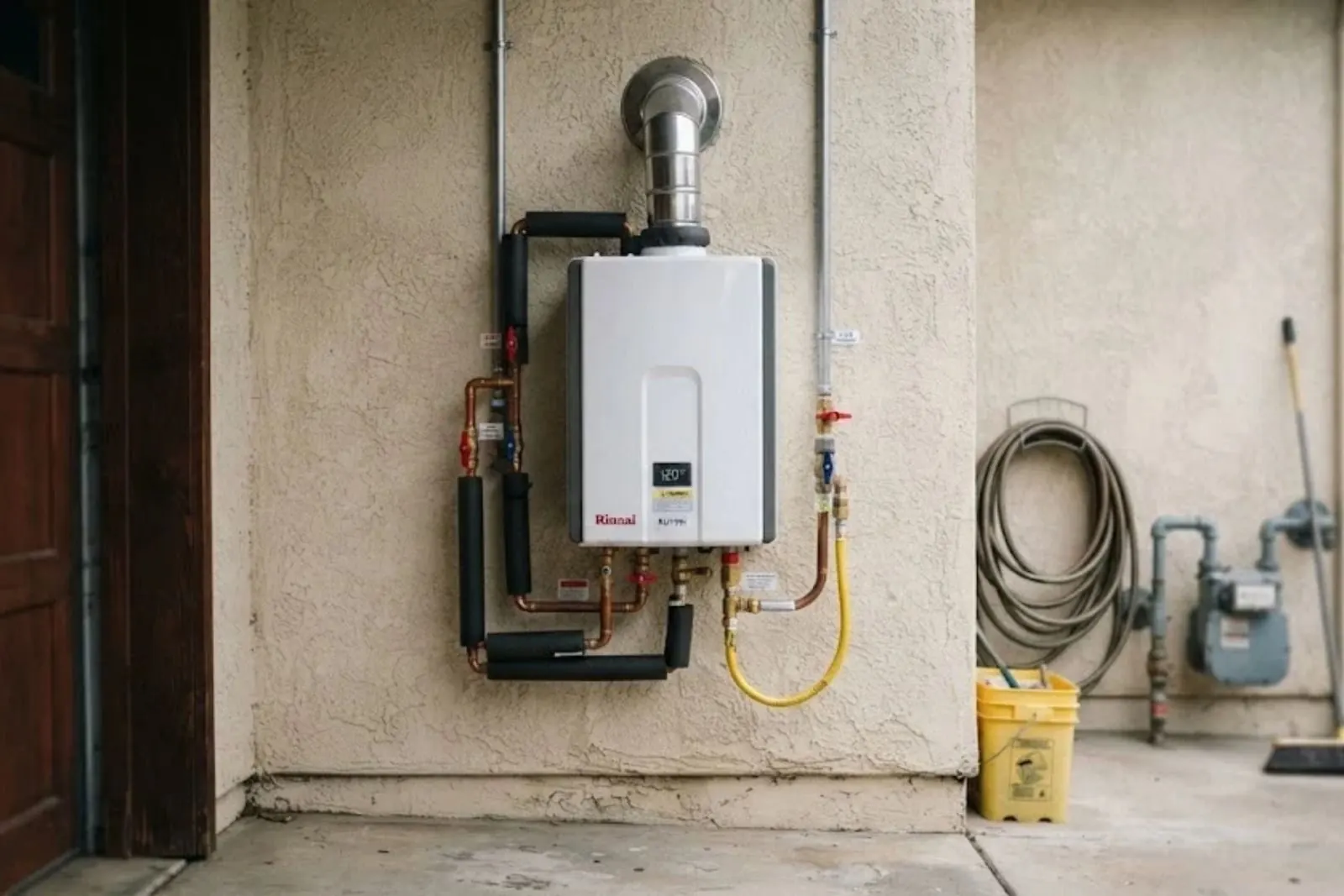
A tankless water heater in El Mirage, AZ heats water as it flows instead of storing a tank of it. That means no standby tank and no running out mid-shower, but it also means a heat exchanger that sees every drop of hard water. The city's 2024 water quality report lists hardness from 4 to 9 grains per gallon with an average of 7.
That number is the reason descaling comes up on almost every tankless conversation here. Mineral scale coats the narrow passages inside the unit, and it builds quietly until the heater slows down, throws an error code, or shuts off.
This page covers whether a tankless unit fits your home, what a flush does and does not fix, and how it compares with a tank. If you are weighing a swap, see the water heater installation page for the planning steps.
Is tankless right for your house?
Tankless is a good fit in some homes and a poor one in others. Here is the honest picture.
Where tankless works well
- Households that want to free floor space.
- Homes where long hot showers back to back are common.
- Owners who will schedule regular flushing.
- Houses where the gas line and vent can be upgraded at reasonable effort.
Where it falls short
- A single unit can struggle if several taps run hot water at once.
- Upfront cost is usually higher than a tank, plus any gas and vent work.
- Hard water scale can cut efficiency and shorten life if ignored.
- A short wait for hot water at distant taps does not go away.
Symptoms that mean it is time to flush
Most tankless service calls start with one of these. A flush clears some of them and not others.
| What you notice | Often related to | Does a flush help? |
|---|---|---|
| Water runs lukewarm even at full demand. | Scale on the heat exchanger. | Often, if the scale is soft. |
| Error code on the display. | Scale, flow sensor, or ignition issue. | Sometimes. The plumber reads the code first. |
| Hot water cuts out in the middle of a shower. | Low flow, a clogged inlet screen, or overheating from scale. | Often, along with cleaning the inlet screen. |
| Loud popping or kettle-like noises. | Scale boiling in the exchanger. | Often, if caught early. |
| Cold burst between two hot runs. | Normal behavior of many units. | No. It is how the unit works. |
| No ignition and a clicking sound. | Gas supply, igniter, or venting fault. | No. This needs a plumber to inspect. |
Descaling and flushing, step by step
A flush circulates a mild acid solution, often vinegar or a manufacturer-approved descaler, through the heat exchanger. Many units have service valves for this. Ask the plumber to do it, or follow your manual if you do it yourself.
Turn off power and gas
Shut off the unit and its gas supply, and close the water isolation valves.
Connect the flush hoses
Hoses link a pump and bucket to the service ports so the solution can circulate.
Circulate the solution
The descaler runs through for the time the manufacturer suggests, loosening mineral buildup.
Rinse and clean the screen
Fresh water flushes out the solution and loosened scale. The inlet screen is cleaned.
Restore and test
Valves are reopened, the unit is restarted, and the plumber checks flow, temperature, and any code.
How often should you flush in 7 gpg water?
No single schedule fits every home. Manufacturers publish their own intervals, and many suggest at least yearly in hard water areas. With the city's reported average of 7 grains per gallon, a yearly flush is a reasonable starting point, and some owners go more often.
How often depends on how much hot water you use, the unit's setting, and whether a softener is in place. Ask the plumber how heavy the scale looks when they open the unit and set the next interval from that.
Treating the water before it reaches the heater cuts scale at the source. See water softener and filtration for what that involves and what the equipment cannot do.
Lukewarm water or an error code?
Note the model and the code, then call. The plumber can tell you whether it sounds like scale or something else.
What a flush cannot fix
Flushing removes loose scale. It cannot undo a cracked heat exchanger, a failed flow sensor, or a unit that has run with heavy buildup for years. If the unit was never flushed, the first service may reveal damage that was hiding under the scale.
A plumber should tell you plainly if the unit is past saving. A repair that costs most of a replacement is a poor trade.
Gas, venting, and sizing basics
Gas tankless units draw a lot of fuel quickly. Many homes need a larger gas line or a different meter setting than a tank used. Venting is also different, often with special pipe. Ask the plumber to check both before you buy.
If you smell gas at any time, leave the building and call the gas utility or 911 before anyone calls a plumber.
Sizing depends on how many fixtures run together and how cold the incoming water is. A unit that is too small gives lukewarm water when demand rises. Ask the plumber to size it from your actual use, not from the box.
Permit questions go to the El Mirage building department. The city adopted the 2018 International Fuel Gas Code, but permit rules for your job are not something this page can state.
When tankless repair is worth it
Repair depends on what failed and how old the unit is.
Inlet screen or flow sensor
Cheap to service and often the cause of cutting out. Usually worth fixing.
Igniter or gas valve
Worth repairing on a newer unit. On an old unit, weigh the part price against replacement.
Scaled heat exchanger
A flush may clear it. If scale has already damaged the exchanger, replacement is the honest answer.
Repeated codes
If the same code returns after service, ask whether a deeper fault or old age is behind it.
Before you book a service visit
- Write down the model number and any error code showing on the display.
- Note when the problem happens, such as lukewarm water at full flow or cutting out.
- Find your manual or the manufacturer's service interval.
- Check whether service valves are installed on the water lines.
- Tell the plumber if you have a softener or conditioner on the water line.
If a tank is the better answer
Some households are better served by a conventional tank, especially if the budget is tight or the gas line cannot be upgraded. If you have a failed tank and are choosing between types, see water heater replacement for the repair-versus-replace decision.
Neighbors in Peoria and Surprise face different water, so do not assume their schedules fit your house.
What affects tankless service and install cost
Prices vary a lot by unit and house. These are the factors.
Homeowners insurance generally does not cover wear, scale, or maintenance work on a heater. It may cover sudden water damage if a fitting fails. Read your policy and ask your agent.
Want a number for your unit? Call and describe the model and symptoms for a clear price before work starts. (623) 301-9042
Frequently asked questions
Usually yes. The city's 2024 report lists hardness of 4 to 9 grains per gallon with an average of 7, and scale builds inside the heat exchanger over time. Check your manual and ask the plumber about an interval.
Some owners do, using a pump, hoses, and descaler. Follow the manufacturer's steps. If the unit has no service valves, if gas is involved in the work, or if you smell gas, stop and call a plumber.
Many tankless units show a brief cold burst when you pause and restart. It is how they work, not always a fault. If the cold lasts or gets worse, have the unit checked.
It can be, mainly for space and for avoiding standby heat loss. The savings depend on use. A plumber can compare your habits against the extra upfront cost.
It reduces scale but does not remove the need for service. Ask the plumber how the softener is set and whether the heater manufacturer has requirements on water treatment.
It depends on the brand, use, and how well scale is controlled. Ask the plumber to read the data plate and judge the unit's condition. No one can give an exact lifespan for your unit.
Question not answered here? Call (623) 301-9042
Sources and code notes
Code reference: El Mirage follows the 2018 International Plumbing Code (IPC) and the 2018 International Fuel Gas Code (IFGC). Ask the El Mirage building department which rules and permits apply to your job. Hardness figures come from the City of El Mirage 2024 water quality report.