
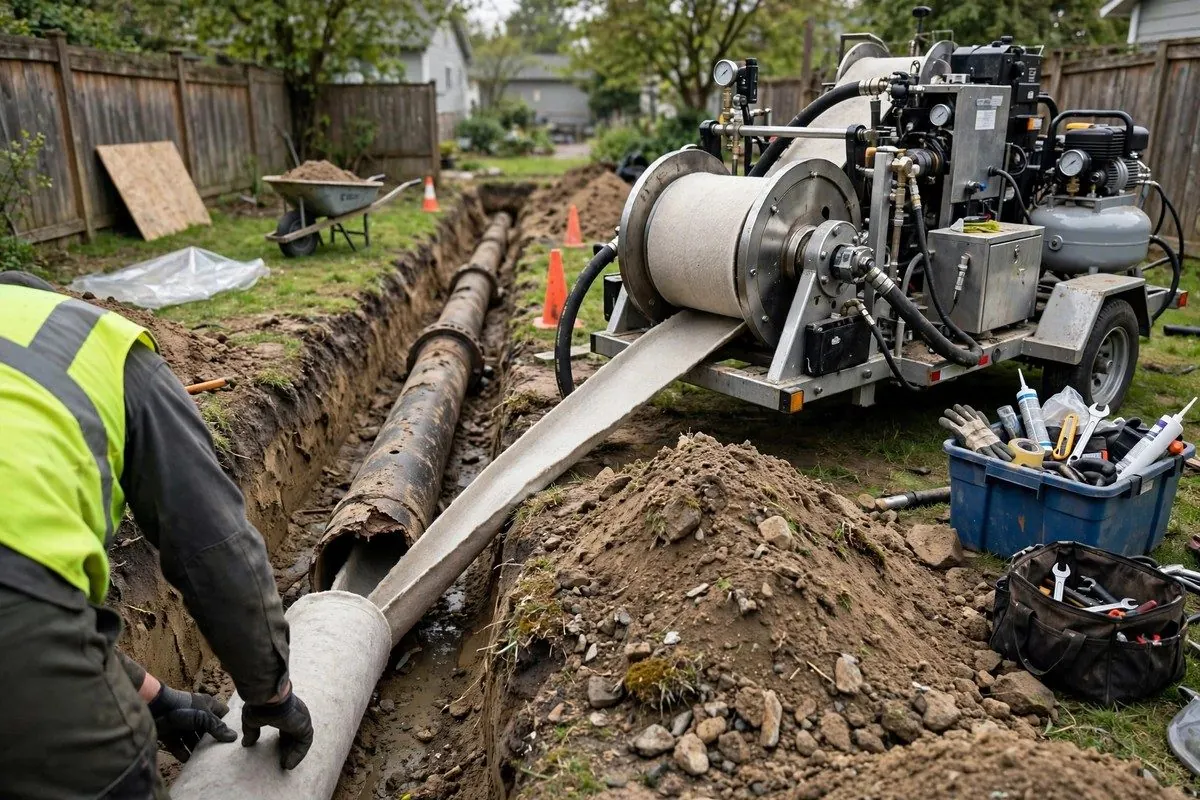
Sewer line repair in El Mirage, AZ means fixing the pipe that carries waste from your house to the city main. If sewage is coming up in a tub or floor drain right now, stop using water, and call the 24/7 emergency line.
Until the plumber gets there, keep every tap, toilet and appliance off. Every flush or load of laundry pushes more waste toward the lowest opening in the house.
A sewer line problem is different from a clogged sink. A sink clog sits in one fixture's branch. A sewer line problem shows up in several drains at once, because they all feed the same pipe.
Sewage in the house is an emergency
Raw sewage on a floor is a health hazard and it spreads fast into carpet, drywall and cabinets. Do not wait for morning if it is rising or if it is reaching living areas.
Keep children and pets out of the wet area. Wear rubber boots and gloves if you must walk through it.
- Stop all water use, including toilets, showers, the dishwasher and the washing machine.
- Shut off power to any room with standing water if you can reach the panel without stepping in it.
- Move rugs, boxes and electronics out of the wet area.
- Do not pour drain cleaner into the line. It will not clear a broken pipe and the chemicals are a hazard to the plumber who opens the line later.
- Call the 24/7 line and tell the dispatcher which drains are backing up.
Sewage in the tub or floor drain: what it points to
When sewage comes up in the lowest drain in the house, the blockage is almost always past the point where your branch lines join. That is the main line, the pipe that runs under the yard or driveway to the city sewer. A snake in one sink will not help.
Two things tend to happen first. A toilet gurgles when the shower drains, or a floor drain bubbles when the washer empties. Those sounds are air being pushed back through a partly blocked pipe.
A backup can have a simple cause, like a grease and wipes clog, which sewer line cleaning can clear. It can also mean the pipe itself is broken, offset or crushed. The only way to tell is to look inside the pipe, which is why the first visit is usually a clearing followed by a camera run.
If the backup clears and then comes back within days, treat that as a sign of damage, not bad luck. Repeat clogs in the same line are the usual reason a clearing turns into a repair.
Signs the line itself is damaged
These are the symptoms homeowners describe most often when the pipe is the problem, not a simple clog.
Several drains slow at once
Tub, shower and toilet all drain slowly together. One shared pipe is restricted downstream of all of them.
Backup keeps returning
The line was snaked and ran for a while, then clogged again. Roots or a broken joint catch debris every time.
Sewer smell outside
A rotten smell near a cleanout, along the yard or by the driveway can mean waste is escaping the pipe.
Wet or sunken ground
A soft patch or a dip in the lawn along the line's path suggests a leak or a collapsed section.
Gurgling fixtures
Toilets that bubble when another fixture drains are signaling a partial blockage in the main.
A short, honest note on septic
El Mirage homes are normally connected to the city sewer, so a septic tank is not the usual situation here. A few properties on the edges of town or in unincorporated pockets nearby may be different.
If you are not sure which system your home uses, say so when you call. The plumber will ask before assuming, because a septic tank problem and a city sewer problem are fixed in completely different ways. Your closing papers or the city's utility billing office can tell you which system you have.
How the plumber finds the break
The goal is to see the damage before anything is dug up. These steps are typical, and the exact order depends on what the plumber finds.
Locate the cleanout
The plumber finds the access point to the main line, usually outside near the house wall, and checks whether the backup is above or below it.
Clear the line
A blocked line has to be opened before a camera can pass. Cabling or hydro jetting may be used, depending on what is blocking it.
Run a camera
A small camera on a cable travels through the pipe. It shows cracks, offsets, roots, sags and the material of the pipe.
Mark the spot
A locator on the camera head lets the plumber mark the problem point and depth on the ground.
Explain the options
You see the footage, hear the choices and get a clear price before work starts.
Is it a clog or a broken pipe?
Tell the dispatcher which drains are slow and whether it has happened before. A plumber can usually tell you what to expect before the visit.
What the damage usually means
| What the camera shows | Likely cause | Typical repair |
|---|---|---|
| Hair-like roots in a joint. | Roots found a gap and grew in. | Cut roots, then repair or replace the joint. |
| Pipe sags and holds water. | Ground settled under the pipe (a belly). | Replace that section with proper slope. |
| Cracked or crushed wall. | Load on the pipe, age or poor bedding. | Dig and replace, or line if the pipe is round enough. |
| Joints pulled apart. | Soil movement | Spot repair at the joint. |
| Grease and wipe buildup, pipe intact. | Clog, not damage. | Clean the line. No repair needed. |
Repair choices and the trade-offs
Most sewer repairs fall into two groups. Which one fits depends on how much of the pipe is damaged, how deep it runs and what sits above it.
Dig and replace a section
- Works for almost any kind of break, offset or sag.
- Lets the plumber reset the slope and fix the bedding.
- Means open trenches, which affects lawn, driveway or patio.
- Best when damage is limited to one short run.
Trenchless options
- Less digging, so less damage to the surface.
- Lining needs a pipe that is still fairly round and clear.
- Cannot fix a bad sag, because the liner follows the old shape.
- Ask the plumber whether your pipe and the damage suit it.
When a repair is not worth doing
Not every backup needs a repair. If the camera shows a clean pipe with only grease or paper clogging it, the fix is cleaning and a change in habits. Paying for a dig would be a waste.
On the other side, a patch can be a poor choice when the line has many cracks, repeated roots or several sags. Paying for one spot repair, then another a year later, can cost more than replacing the full run once.
Ask the plumber to show footage of the whole line, not just the worst spot. Then decide whether to repair one section or plan a larger job. A pre-purchase sewer camera inspection follows the same logic.
Before anyone digs in your yard
Digging is where sewer jobs can go wrong. These points keep the work safe and legal.
- Arizona law requires a call to Arizona 811 before digging. The request is free, and utility locators have two full working days to respond.
- Wait for the utility marks before the trench starts. Marks stay valid for 15 working days.
- Within 24 inches of a mark, only hand tools are allowed.
- Ask the El Mirage building department whether your specific repair needs a permit. Do not assume it does or does not.
- Confirm the plumber's Arizona contractor license on the ROC website before you sign.
- Ask where the old pipe and spoil dirt will go and who restores the lawn or concrete.
What roots and ground movement do here
According to Census-based data, the median El Mirage home was built around 2004. Newer tract homes can still have sewer problems, usually from settling soil, loose joints or tree roots chasing moisture. Pipe material for any one house is not known without looking, so ask the plumber to confirm it on camera.
The Arizona Geological Survey notes that groundwater pumping has caused subsidence and fissures in parts of Maricopa County. That is a general regional fact and not a statement about your street. For you, the practical meaning is simple. If a pipe sags, the camera will show it, and the repair will fix the slope.
What sets the price of a sewer repair
Two sewer repairs can differ a lot in cost. The camera footage is what turns a guess into a real price.
Homeowners insurance often does not cover the repair of a worn or root-damaged sewer pipe, though some policies cover sudden and accidental damage and some offer a sewer backup add-on. Read your policy and ask your agent before the work starts.
Want a real price for your line? Call the 24/7 number and describe what is backing up. (623) 301-9042
Frequently asked questions
Yes. The emergency line is answered 24/7, including weekends and holidays. A sewage backup does not wait for business hours, and neither does dispatch.
Most El Mirage homes are on city sewer, so a septic tank is not the usual case. Some properties nearby may differ. If you are unsure, tell the plumber and ask before any work is planned, because the repairs are very different.
A snake opens a hole through the clog but does not repair the pipe. If roots, a sag or a cracked joint is the cause, debris collects again and the backup returns. A camera inspection after the clearing shows why.
Sometimes. Lining or other trenchless methods can work when the pipe is still round and the problem is a crack or a leaking joint. They do not fix a bad sag. The plumber should show you footage and explain which method suits your line.
Most homes here are newer, so older cast iron is less common than in historic neighborhoods, but the material in any one house is not known without checking. The camera shows what the pipe is made of. If it is cast iron, ask whether it is scaled, cracked or leaking.
Responsibility usually depends on where the pipe sits relative to the property line and the city main. Ask El Mirage customer service where the city's part ends. The plumber can mark where the break is on your side.
Yes. The same line covers neighbors in Surprise and nearby towns. Tell the dispatcher your address and the symptoms when you call.
Question not answered here? Call (623) 301-9042
Sources and code notes
Code reference: El Mirage follows the 2018 International Plumbing Code (IPC) and the 2018 International Fuel Gas Code (IFGC). Ask the El Mirage building department which rules and permits apply to your job. Dig-safety timing comes from Arizona 811, which the Arizona Corporation Commission oversees.