
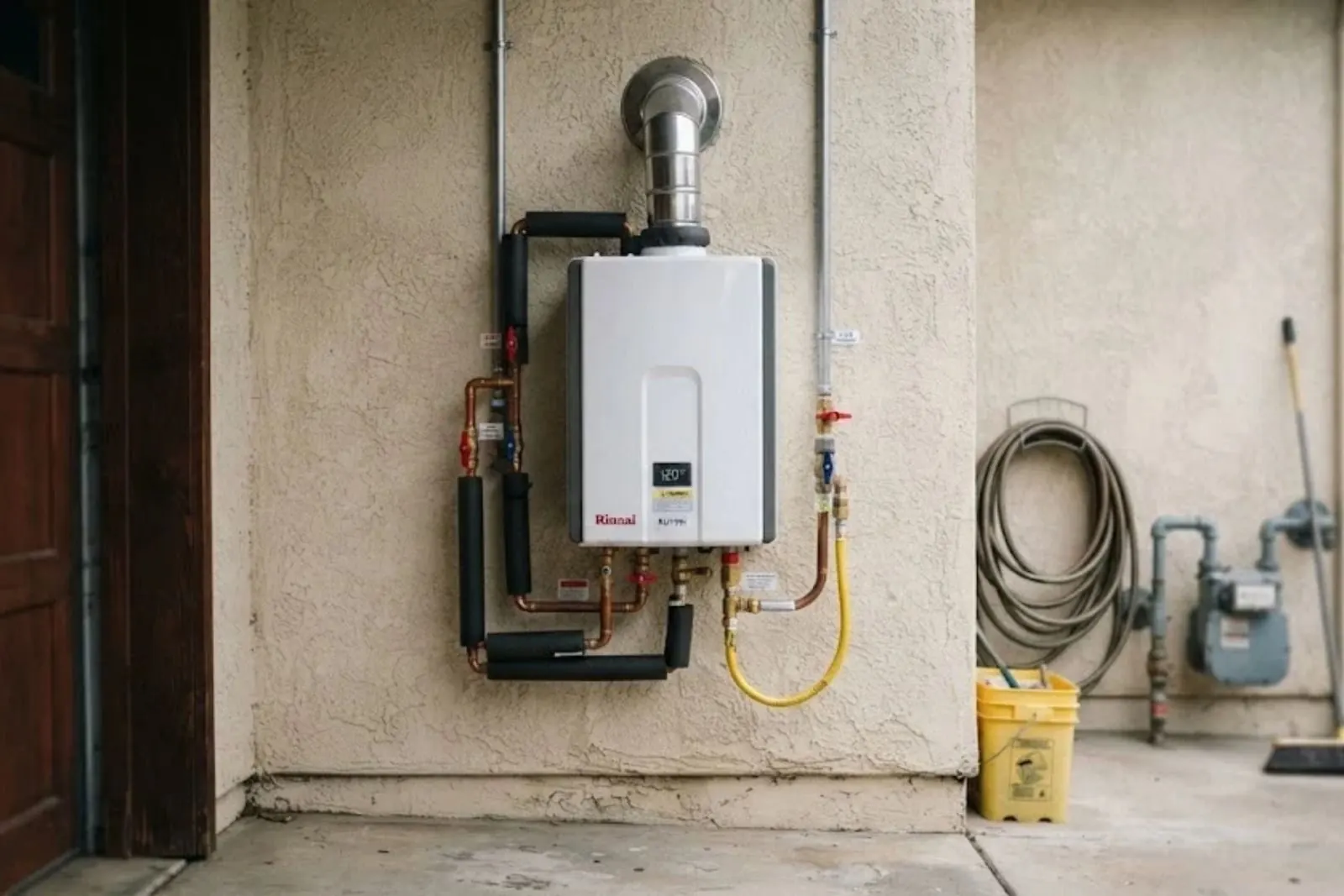
To flush a tankless water heater with vinegar, you shut off power or gas, close the water, connect a small pump and two hoses to the service valves, and circulate white vinegar through the unit for a set time. Then you rinse it with clean water and put everything back.
Your manufacturer's instructions come first. They name the vinegar strength, the amount, the time and the valves. Some brands call for their own descaling solution or do not allow vinegar at all. If your manual is missing, look up the model online or call a plumber.
Read this before you touch anything
Find the model number on the heater and pull the manual for it. Follow the maker's flush steps exactly, including which valves to use and how long to circulate.
The next sections describe how most flushes go, so you know what to expect. They are a general picture, not a replacement for your manual. If the heater is gas, you are also working near a gas line. If you ever smell gas, leave the building and call the gas utility or 911 first.
What you need on the bench
- Your manufacturer's flush instructions, printed or open on your phone.
- Isolation valves with service ports already installed. Without them, a flush is much harder.
- A small submersible pump, usually rated for hot or chemical use, and two hoses with the right fittings.
- A clean bucket large enough to hold the vinegar and the rinse water.
- White vinegar in the quantity your manual calls for, or the maker's own descaling product.
- A screwdriver or wrench for the service port caps, plus a towel for drips.
- A pair of gloves and eye protection for splashes.
How the flush usually goes
Details change by brand, so treat this as a map of the process and follow your own manual for the numbers.
Turn it off
Switch off power to the unit and shut the gas valve. Let the heater cool, since the water inside can be very hot.
Close the water
Close the cold and hot isolation valves so the heater is cut off from the house plumbing. Open a hot tap in the house to relieve pressure if the manual says to.
Connect the pump
Attach one hose from the pump to the cold service port and a second hose from the hot service port back into the bucket.
Fill the bucket
Pour in the vinegar amount your manual specifies, with water if the instructions call for dilution.
Open the ports and circulate
Open the service ports, run the pump and let the solution loop for the time in your manual. Many sources cite roughly an hour, but trust your manual.
Drain and rinse
Stop the pump, drain the vinegar from the unit and flush with clean water until the vinegar smell is gone.
Clean the inlet filter
Many units have a small screen at the cold inlet. Pull it, rinse off any grit and put it back.
Restore everything
Close the service ports, open the isolation valves, check for drips, open the gas, restore power and run hot water to confirm normal operation.
Want a plumber to look at it?
Call the 24/7 line, describe what you found and hear a clear price before work starts.
Vinegar or the maker's descaler?
Both work on mineral scale, but they are not interchangeable in every manual.
White vinegar
- Easy to find and inexpensive.
- Allowed by some manufacturers and prohibited by others.
- Strong smell, so ventilate the room.
- Needs a thorough rinse so no acid is left in the lines.
Maker's descaling solution
- Matches the materials in your heat exchanger.
- Directions are written for your exact model.
- May be required to keep warranty coverage intact.
- Costs more and may need ordering ahead.
Signs the heater needs a flush
| What you notice | What scale may be doing | What to check |
|---|---|---|
| Hot water takes longer to arrive. | Scale on the heat exchanger slows heat transfer. | Compare to how it ran when new. |
| Temperature swings in the shower. | Flow through the unit is uneven. | Check the inlet filter for grit. |
| Error codes on the display. | Many models flag flow or temperature problems from buildup. | Look up the code in the manual. |
| Rumbling or kettle-like sounds. | Water boiling in scaled passages. | Stop and have it checked if it persists. |
| Lower flow at the tap. | Clogged screens or narrowed passages. | Test other taps to rule out fixtures. |
What do you do with the used vinegar?
The liquid coming out of the unit carries dissolved minerals and may be cloudy or tinted. Most manuals allow it to go down a household drain with plenty of running water, but check yours. Keep it out of planted beds and off the ground.
Wipe up any splashes right away, since vinegar can dull some finishes. If you notice a drip at a service port afterward, tighten the cap by hand, wipe it dry and watch it for a while before you walk away.
When a vinegar flush is not enough
A flush cannot repair a cracked heat exchanger, a failed sensor or a bad control board. If an error code returns right after a flush, the scale may not have been the cause. At that point a plumber can test the unit instead of you guessing at parts.
A flush also does nothing about the next batch of minerals coming in with your water. If the heater scales quickly, ask about a water softener or filtration system so the same job does not come back every year. Your tankless water heater service visit is a good time to raise that.
El Mirage water and how often to check
The city's 2024 water quality report lists El Mirage groundwater hardness of 4 to 9 grains per gallon, with an average of 7. That is enough mineral to build scale in a tankless heat exchanger over time, so do not assume the heater can go untouched for years. Ask the maker how often to flush in hard water, and check the latest city report for current numbers.
Hardness differs from town to town in this part of Maricopa County. Surprise's city report for its Mountain Vista system listed 2.5 to 5.3 grains per gallon in 2022, and it varies by neighborhood water system. Youngtown is served by EPCOR, whose 2025 report for Sun City and Youngtown lists 7 to 11 grains per gallon. If a friend in Surprise says they never flush, their water may not match yours.
Frequently asked questions
Follow the interval in your manual. Makers often give a range that depends on water hardness and daily use. With hard water, the shorter end is the safer plan.
Not easily. Without service ports, you would have to disconnect the water lines, which is a plumbing job. A plumber can add isolation valves so future flushes are simple.
Do not. Circulate for the time in your manual, then drain and rinse with clean water. Leaving acid in the lines longer than the maker allows is a risk to seals and fittings.
If you are comfortable with valves, hoses and a manual, many homeowners can do it. Call a plumber if the unit is gas and you are unsure about shutoffs, or if the heater shows persistent errors after a flush.
The city's 2024 report lists 4 to 9 grains per gallon, averaging 7. Surprise's Mountain Vista system reported a softer range in 2022, and Youngtown's EPCOR report lists a harder range. Check your own provider's latest report, since Youngtown homeowners and El Mirage homeowners may see different results.
Question not answered here? Call (623) 301-9042
Sources and code notes
Code reference: El Mirage follows the 2018 International Plumbing Code (IPC) and the 2018 International Fuel Gas Code (IFGC). Ask the El Mirage building department which rules and permits apply to your job. Hardness figures come from the City of El Mirage 2024 water quality report.