To test for a leak, stop all water use in the house, read the meter, wait at least 30 minutes, and read it again. If the numbers or the leak dial moved, water is escaping somewhere on your property. If nothing moved, the leak is unlikely, and the bill may reflect use, irrigation or a read that needs to be checked.
Run the test before you call anyone. It costs nothing and it tells a plumber and city customer service exactly where to look first.
Start here: is the jump a leak, a habit or a read?
A high bill has three common explanations. The meter test and a look at your recent habits separate them.
Points toward a leak
- The meter moves with every fixture off.
- The bill rose and nothing in the household changed.
- You hear water at night or see a damp spot.
- The water heater seems to run more than usual.
- The rise appears on more than one statement.
Points toward use or a billing question
- The meter holds still during the test.
- You had guests, filled a pool or watered new plants.
- Irrigation timers changed with the season.
- The statement read does not match what your meter shows.
- The rise is a single cycle with no other clues.
The meter test, step by step
Stop all water use
Close taps and make sure the dishwasher, washing machine, ice maker and irrigation are off. Do not flush while you test.
Open the meter box
It is typically in a ground box near the street. Lift the lid with a tool and watch for insects. Wipe the glass if it is dirty.
Check the leak indicator
A spinning dial or flashing triangle means water is passing through the meter. A completely still indicator is a good sign.
Record the register
Photograph the full read with a time stamp. Some meters have more digits than your bill shows, so use the digits that move first.
Wait at least 30 minutes
A longer wait, such as two hours, catches slower leaks. Keep the house quiet the whole time.
Read again and compare
Any change means water is moving. Write down the difference and the time, since a plumber can use it to gauge how big the leak is.
Close the house main and test again
If the meter keeps moving with the main closed, the leak is between the meter and the house. If it stops, the leak is inside the home plumbing.
Reading the result
| Result | What it suggests | Next step |
|---|---|---|
| Meter still, house main open. | No steady leak right now. | Check irrigation and habits, then ask city customer service to verify the read. |
| Meter moves, house main open, stops when main closed. | Leak inside the house plumbing. | Check toilets, heater and fixtures, then call a plumber. |
| Meter moves even with the house main closed. | Leak on the buried service line. | Call a plumber for the underground water line. |
| Meter moves only at certain times. | Irrigation, softener, or a fill valve cycling. | Check timers, softener regeneration and toilet tanks. |
| Meter moves very slowly. | A toilet flapper or small drip is common. | Try the dye test in each toilet tank. |
Want a plumber to look at it?
Call the 24/7 line, describe what you found and hear a clear price before work starts.
Where water usually escapes
Toilets
A worn flapper can leak into the bowl all day with little sound. Dye in the tank shows it in minutes.
Irrigation
A stuck valve, a cracked line or a timer set wrong can use more water than the rest of the house combined.
Water heater
A leaking relief valve or tank connection can hide in a closet or garage.
Outdoor hose bibs
A dripping bib or a hose left connected can run for days without anyone noticing.
Underground line
A break between the meter and the house shows up as a moving meter with the main closed, and sometimes as a wet patch in the yard.
What to gather before you call
Whether you call the city or a plumber, the same short list saves time.
- The meter reads and times from your test.
- Whether the meter kept moving with the house main closed.
- The last two or three bills so you can show the change.
- Notes on any wet spots, odd sounds or a heater that runs often.
- Whether you have a pool, irrigation, a softener or an ice maker.
- A photo of the meter showing the leak indicator, if it is moving.
What a plumber can add that the meter cannot
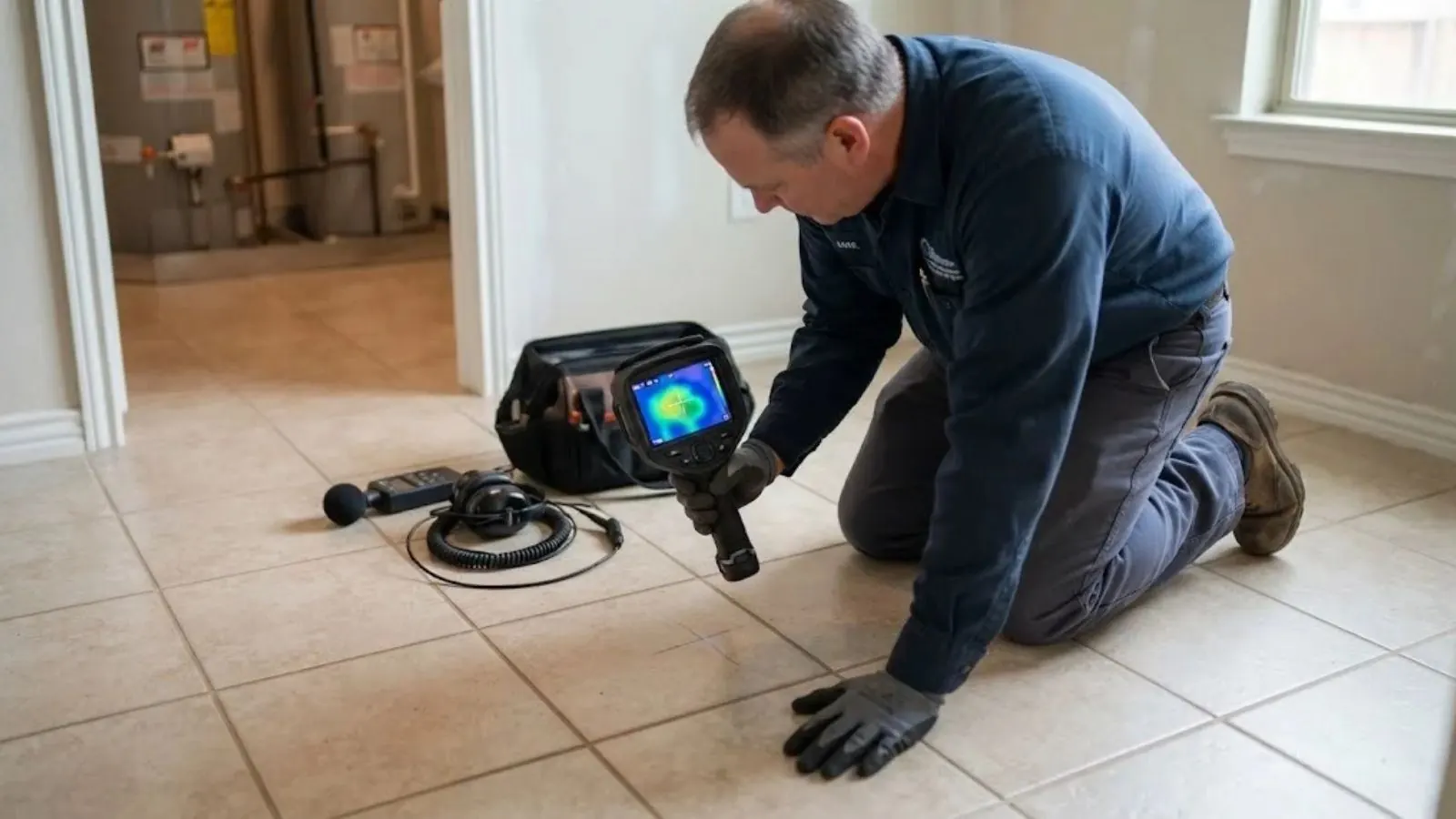
The meter tells you that water is leaving. It does not say where. A plumber typically isolates sections with shutoffs and pressure tests, then uses listening or other tools for finding the leak.
If the line between meter and house is the problem, water line repair may involve digging. Before anyone digs, Arizona 811 must be contacted, and utilities have two full working days to respond. Ask the plumber to compare a spot repair with a full replacement, and get the price before work starts.
Will the city adjust a bill after a leak?
Many utilities have some way to review a bill after a verified leak, but we do not know the details of El Mirage's process. Contact city customer service and ask what proof they want, such as a repair invoice or meter photos.
Keep the plumber's written description of what was found and fixed. Do not assume an adjustment is available until the city confirms it.
Checking your bill in El Mirage
Water service in El Mirage is run by the city's Public Works department, in its Water Services Division. For a leak report or a question about a leak adjustment, contact city customer service. The city's published pages say little more than that, so call and ask.
In 2023 the city investigated inaccurate meter readings in one billing cycle that raised bills for a small number of customers. That does not mean your bill is wrong. It does mean a sensible order of steps is to check for a leak first and then ask utility billing to verify the read.
The city's 2024 water quality report lists hardness from 4 to 9 grains per gallon, with an average of 7. Scale can make a toilet fill valve or an irrigation valve stick open, so an old, scaled part is a common cause of a high bill.
Frequently asked questions
Thirty minutes shows most active leaks. For a small leak, a wait of two hours or an overnight check is better. Compare the first and last reads.
It might be. A slow drip from a toilet flapper can move the dial just enough to see. Try the dye test in each toilet tank, then repeat the meter test.
Look at irrigation schedules, guests, pool filling and season changes. If those do not explain it, ask city customer service to verify the read.
Use the shutoff valve at your house first. The meter-side valve may belong to the utility, so ask city customer service before you operate it.
The city investigated inaccurate readings in one billing cycle, and a small number of customers saw higher bills. We know little beyond that, so if your bill jumps, do the meter test and ask utility billing to verify the read.
Question not answered here? Call (623) 301-9042
Sources and code notes
Code reference: El Mirage follows the 2018 International Plumbing Code (IPC) and the 2018 International Fuel Gas Code (IFGC). Ask the El Mirage building department which rules and permits apply to your job. Hardness figures come from the City of El Mirage 2024 water quality report. Dig-safety timing comes from Arizona 811, which the Arizona Corporation Commission oversees.