
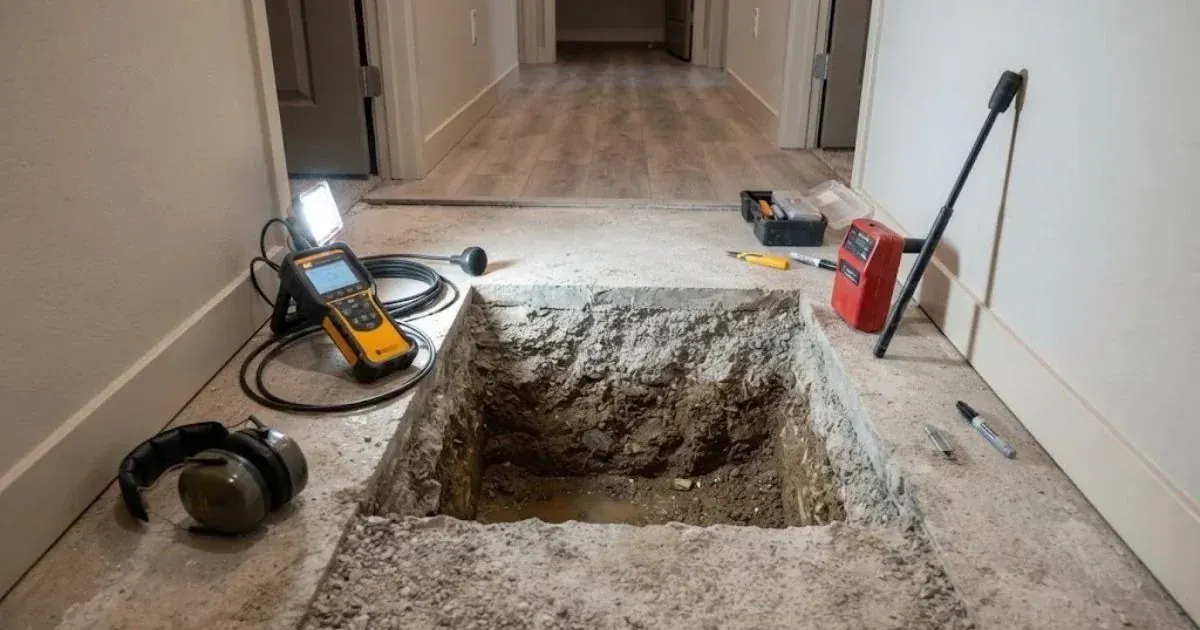
A slab leak is a leak in a water pipe that runs under or inside a concrete slab foundation. You usually cannot see it, so you detect it by its side effects. Look for a water meter that keeps moving when every fixture is off. Look for a bill that climbs with no change in habits, a floor that feels warm in one spot, running water you can hear in a quiet house, or damp flooring and baseboards.
The most reliable home check is the meter test. Turn off everything that uses water, read the meter, wait, and read it again. If the numbers moved, water is escaping somewhere, and a plumber can then work out whether it is under the slab or elsewhere.
What does a slab leak look like from inside the house?
Most people never see the pipe. They notice one of these signs first, and often two or three together.
Warm or hot spot on the floor
A leaking hot line can heat the concrete above it. Bare feet find it before anything else does. Tile and wood floors both pass the warmth through.
Water sound with nothing running
A hiss or trickle at night, when the house is silent, can mean pressurized water is escaping from a pipe. Put your ear near the floor or the base of a wall.
Damp carpet, lifting tile or swollen baseboard
Water finds the weakest path up through slab cracks and wall bases. Flooring that cups, buckles or smells musty needs a closer look.
A higher bill with no new habits
Slow leaks run all day and night. The cost shows up on the statement long before anything shows on the floor.
A meter that moves when you are not using water
This is the clearest sign of any hidden leak. It does not tell you where the leak is, only that one exists.
Low hot water pressure or a heater that runs more
If the leak is on the hot side, the heater keeps refilling and reheating. You may notice weaker flow at the taps.
Step by step: the meter test you can do in ten minutes
This test separates a hidden leak from normal use. Do it when nobody is home or everyone has agreed to stop using water.
Shut off every water use
Turn off taps, dishwasher, washing machine and ice maker. Check that no toilet is refilling and no sprinkler zone is running.
Find the meter box
It is typically in a ground-level box near the street or property line. Lift the lid carefully, since insects and spiders like the shade, and use a screwdriver or a gloved hand.
Look at the leak indicator
Many meters have a small dial or triangle that spins when any water moves. If it turns with everything off, you already have your answer.
Write down the read
Note every digit on the register. Take a phone photo so you have a record with the time.
Wait and read again
Give it at least 30 minutes with no water use, or a few hours if you can. A change in the numbers means water is leaving the system.
Close the home shutoff and recheck
If the house main is closed and the meter stops, the leak is inside the house side. If it keeps moving, the leak is between the meter and the house, often an underground line.
What each clue usually points to
No single sign proves a slab leak. Use the table to see how clues fit together and what the next step looks like.
| What you notice | What it may mean | What to do next |
|---|---|---|
| Warm spot on the floor, heater is gas or electric and working normally. | A hot water line may be leaking under the slab. | Run the meter test, then call a plumber to locate the line with listening and thermal tools. |
| Meter moves, home shutoff closed, meter stops. | Leak is inside the house plumbing, possibly under the floor. | Check toilets and fixtures first, then call for leak detection. |
| Meter moves with the home shutoff closed. | Leak is on the service line between the meter and the house. | Call a plumber for the underground water line. |
| Damp spot along one wall base. | Leak could be under the slab, in the wall, or a drain issue. | Photograph it, mark the edge with pencil, and watch whether it grows. |
| Sound of running water at night, meter still. | Possibly a faint fixture drip, or noise from water hammer. | Check each fixture, then repeat the test with more patience. |
| Bill jumped, nothing else odd. | Could be irrigation, a toilet flapper, a leak, or a billing problem. | Do the meter test, then ask city customer service about the reading. |
Want a plumber to look at it?
Call the 24/7 line, describe what you found and hear a clear price before work starts.
Quick checks that rule out the cheap culprits
Many suspected slab leaks turn out to be something simpler. Spend a few minutes on these before you assume the worst.
- Drop a few drops of food coloring in each toilet tank and wait 15 minutes without flushing. Color in the bowl means a leaking flapper.
- Look at the water heater base and the pressure relief discharge pipe for drips or mineral crust.
- Check hose bibs, irrigation valves and the sprinkler controller. A stuck zone valve can keep water flowing all day.
- Listen at each sink, tub and washing machine box for a faint hiss.
- Feel along the floor in each room, slowly, with bare feet or the back of your hand.
- Check the ceiling below any upstairs bathroom if you have a two-story home, since that is a different leak path.
Can you pinpoint it yourself, and where does DIY stop?
You can confirm that a leak exists. Finding the exact spot under concrete is another matter.
What you can do at home
- Read the meter and run the shutoff test.
- Check toilets, heater, hose bibs and irrigation.
- Note warm spots, damp areas and sounds, with dates.
- Close the main valve if water is actively damaging the home.
- Photograph the meter and any damage for your records.
What needs a plumber
- Locating the leak to a few feet using listening gear and thermal imaging.
- Telling a hot line from a cold line leak.
- Deciding between repair, reroute or replacing the line.
- Opening flooring or concrete only where needed.
- Pressure testing sections of pipe to isolate the failure.
What the plumber does to find a slab leak
A plumber typically starts by confirming the symptoms and closing off parts of the system to narrow the search. Pressure tests on the hot and cold lines show which side is losing water.
Electronic listening equipment picks up the sound of water escaping, and thermal imaging can show warm paths on the floor. Leak detection methods like these reduce the amount of flooring or concrete that has to be opened. They are not perfect, and a very small leak or a noisy pipe can make a result less certain.
Once the leak is located, the options usually are a spot repair, rerouting the line through walls or attic, or repiping if several lines are failing. The right choice depends on pipe condition and access. Ask the plumber to explain why they recommend one option over another.
Should you wait and watch, or act now?
Act now if the meter is moving with everything off. A leak that runs for weeks can undermine flooring, raise your bill and soften the soil near the foundation.
Close the main valve if you hear water or see it spreading. If a ceiling, outlet or appliance is wet, stay clear and call the 24/7 line. For a confirmed leak under the floor, our page on slab leak repair explains the repair options in more detail.
What El Mirage homeowners should know before testing
Census-based data puts the median El Mirage home at about 2004, and most homes date from the 2000s boom. That tells you many homes are newer tract builds, but it does not tell you the foundation type or pipe material of your house. Ask the plumber to confirm what your home actually has before you assume a slab leak.
The city's 2024 water quality report lists groundwater hardness of 4 to 9 grains per gallon, with an average of 7. Mineral scale from hard water can clog small fittings and valves, so a fixture that drips is more often a worn part than a slab problem. Rule that out first.
If the meter test points to a leak and your bill looks off, contact city customer service. Ask about the read and about any leak adjustment, since the city's water utility is run by its Public Works department.
Frequently asked questions
It depends on the size of the leak and what is above it. A small pinhole can run for months before flooring shows damage, while a larger break can soak carpet and drywall quickly. Either way, the water bill climbs the whole time, so early detection saves money.
No. Pipes do not seal over, and a leak under pressure usually grows as the water wears the opening wider. Shutting off the water at the main stops the flow but does not repair the pipe.
No. Sun on a window, a heater duct under the floor, or a nearby hot water line can all warm a floor. A warm spot plus a moving meter is the combination that deserves a call.
Policies differ. Many cover sudden and accidental damage but not wear and tear, and some treat access costs differently. Read your policy and ask your agent before you file a claim.
Do the meter test first. If the meter moves with the home shutoff closed, the leak is between the meter and the house, so call a plumber. If you only suspect a billing error, contact city customer service to verify the read, which is worth doing after the 2023 meter-read issue the city investigated. Neighbors in Youngtown and Peoria have different water utilities, so their steps may differ.
Question not answered here? Call (623) 301-9042
Sources and code notes
Code reference: El Mirage follows the 2018 International Plumbing Code (IPC) and the 2018 International Fuel Gas Code (IFGC). Ask the El Mirage building department which rules and permits apply to your job. Hardness figures come from the City of El Mirage 2024 water quality report.