
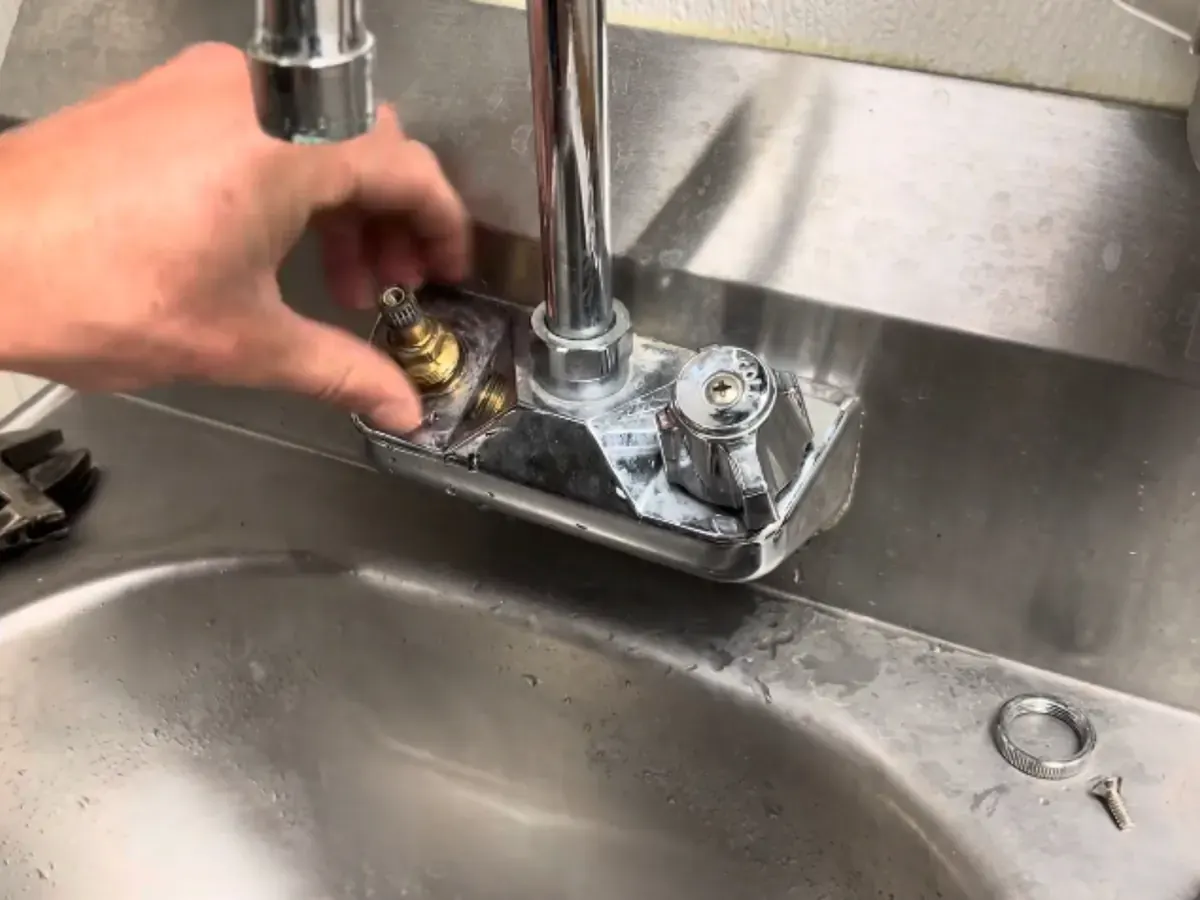
Most kitchen faucet problems come from four small parts: the cartridge or valve inside the handle, the O-rings at the spout base, the aerator on the tip, and the supply lines under the sink. A drip from the spout usually means a worn cartridge. Water at the base of the spout usually means worn O-rings. Weak flow usually means a clogged aerator.
You can handle an aerator cleaning and a cartridge swap with basic tools if the shutoff valves under the sink work. Call a plumber when the valves will not close, the faucet body is corroded or cracked, or water is getting into the cabinet and you cannot find where.
What is your faucet actually doing?
Start with the symptom. It points to the part that has failed, so you buy one repair kit instead of guessing.
| What you see | Most likely part | DIY level | Call a plumber if |
|---|---|---|---|
| Drip from the spout when off. | Cartridge, valve seat or washers. | Moderate | The valve seat is pitted or the handle will not come off. |
| Water pooling around the spout base. | Worn O-rings or a loose collar. | Easy to moderate. | The spout body is cracked or corroded. |
| Low or uneven flow. | Clogged aerator or sediment in the cartridge. | Easy | Flow is weak at every tap in the house. |
| Handle wobbles or feels stiff. | Loose set screw or worn cartridge. | Easy | The handle seizes after you clean it. |
| Wet cabinet floor under the sink. | Supply line, shutoff valve or drain connection. | Moderate | You cannot tell which connection is leaking. |
| Hot side runs lukewarm. | Cartridge, supply line kink or the water heater. | Moderate | Other fixtures also run lukewarm. |
Check these first, before you take anything apart
Five minutes of looking saves a lot of unnecessary work.
- Dry the faucet and the cabinet floor, then watch for 10 minutes to see exactly where the water appears.
- Unscrew the aerator at the tip and look for white or tan grit. Scale in that grit is mineral buildup from the water.
- Open and close both shutoff valves under the sink. If either one is stuck, leave it alone and plan to call a plumber.
- Look at the faucet brand on the body or in the cabinet. Cartridge parts are brand and model specific.
- Take a photo of the faucet and the supply lines before you start so you can match parts at the store.
How do you replace a faucet cartridge?
This is the most common repair for a drip. The details change by brand, so treat this as the general order of work.
Shut off the water
Close both shutoff valves under the sink. Open the faucet to drain pressure, and plug the drain so small screws cannot fall in.
Remove the handle
Look for a decorative cap, then a set screw or a screw under it. Lift the handle straight off.
Pull the cartridge
Remove the retaining nut or clip, then pull the cartridge straight up. Note which way the tabs face before it comes out.
Match the part
Bring the old cartridge to the store or match the model number. A near match often leaks or limits the hot and cold range.
Clean and reassemble
Wipe mineral scale from the valve body, seat the new cartridge, and reassemble in reverse order.
Test slowly
Open the shutoff valves slowly, then run the faucet and check the cabinet for drips for several minutes.
Want a plumber to look at it?
Call the 24/7 line, describe what you found and hear a clear price before work starts.
Repair or replace the whole faucet?
A repair kit is cheap in parts but not always the better choice. These lists show which way each situation tends to lean.
Repair usually makes sense when
- One part has failed and the rest of the faucet looks clean.
- The faucet is a recognizable brand with parts still sold.
- The finish is intact and the handle moves smoothly.
- You like the faucet and the sink holes match it.
Replacement usually makes sense when
- You have repaired the same faucet more than once.
- The body is pitted, cracked or crusted with scale.
- Parts are no longer available for the model.
- You want a pull-down sprayer or a different style anyway.
Why does the faucet drip again a few months later?
A repeat drip usually has one of three explanations. The new part was a near match instead of an exact one, the valve seat inside the faucet is worn and chews up each new seal, or scale is lifting the seal off its seat. A seat that is pitted cannot be fixed by swapping a cartridge.
Over-tightening causes it too. Cranking the retaining nut flattens seals and cracks plastic housings. Snug is enough, and a plumber can tell you quickly whether the body is worth another repair.
Where DIY stops
Stop and call if a shutoff valve will not close, because forcing it can snap the stem and leave you with no way to stop the water. Stop if you see green corrosion on supply lines or fittings, or if the leak is coming from inside the wall.
A plumber can replace shutoff valves, supply lines and the faucet itself. For a quick look at the options, see how faucet repair works from the plumber's side.
What affects the cost of a faucet repair?
Price depends on the job, not the faucet alone. Call for a clear price before work starts and ask what it includes.
Parts availability
A common cartridge is simple to source. A discontinued model can push the job toward replacement.
Shutoff valve condition
If the valves under the sink do not close, they usually get replaced first so the repair can happen safely.
Faucet type
A pull-down sprayer, touchless model or wall-mounted unit takes longer than a basic two-handle faucet.
Hidden damage
Water that reached the cabinet or the drain connection adds work beyond the faucet.
Fixture supplied or not
Replacing with a faucet you bought differs from the plumber supplying one. Ask who provides the part and what the warranty covers.
Questions to ask before a plumber starts
- Is the price for the repair only, or does it include new shutoff valves and supply lines if they are needed?
- If the faucet is not worth repairing, what are my replacement options and what changes in the price?
- Are you licensed and insured for plumbing work in Arizona?
- Will you test for leaks under the sink after the repair?
- What happens to the old parts, and can I see the failed one?
What El Mirage water does to kitchen faucets
The city's 2024 water quality report lists hardness from 4 to 9 grains per gallon, with an average of 7. Water in that range leaves mineral scale on aerators and valve seats over time, so cleaning the aerator once or twice a year is a reasonable habit. If your flow keeps dropping, scale is the first suspect.
Census-based data puts the median home in El Mirage at about 2004, and most homes date from the 2000s boom. A kitchen faucet that has never been replaced in one of those homes is often twenty years old, so a repair may be worth weighing against replacement. Ask the plumber to confirm the faucet's age and parts availability.
The same city report says trapped air does not harm plumbing. If your faucet sputters after water service work nearby, run the tap for a minute before you assume the faucet has failed.
Frequently asked questions
Often yes. Aerator cleaning, tightening a loose handle and replacing a cartridge are manageable with a screwdriver, an adjustable wrench and the correct part. The risk is in the shutoff valves and old fittings, which can fail when you disturb them. If anything under the sink looks corroded or will not move, stop there.
Find the brand and model on the faucet body, the original paperwork or a sticker in the cabinet. If you cannot find it, take the old cartridge to a plumbing supply counter and match it by hand. Guessing by size alone often leads to a leaky near match.
O-rings in the swivel joint wear out and let water creep down the outside of the spout. The fix is new O-rings, sometimes with a light coat of plumber's grease. If the spout body itself is cracked or pitted, replacement is the better option.
Yes, a steady drip adds up over weeks, and it also wears the valve seat faster. If your bill climbs and you have already checked faucets, a leak detection visit can rule out a hidden leak elsewhere.
The same licensed plumbers cover neighboring towns. See the pages for plumbers in Surprise and plumbers in Peoria for details.
If your water bill jumps, check for a leak first, then contact the city customer service office and ask utility billing to verify the meter read. The city looked into inaccurate meter readings in 2023 that raised bills for a small number of customers. A dripping faucet alone rarely explains a large jump, so a plumber can help rule out other sources.
Question not answered here? Call (623) 301-9042
Sources and code notes
Code reference: El Mirage follows the 2018 International Plumbing Code (IPC) and the 2018 International Fuel Gas Code (IFGC). Ask the El Mirage building department which rules and permits apply to your job. Hardness figures come from the City of El Mirage 2024 water quality report.